
Home / Diana França
Diana França
A diplomat in training, a self-taught bag maker, a day trader. Every detour taught her a different part of the machine she now runs.
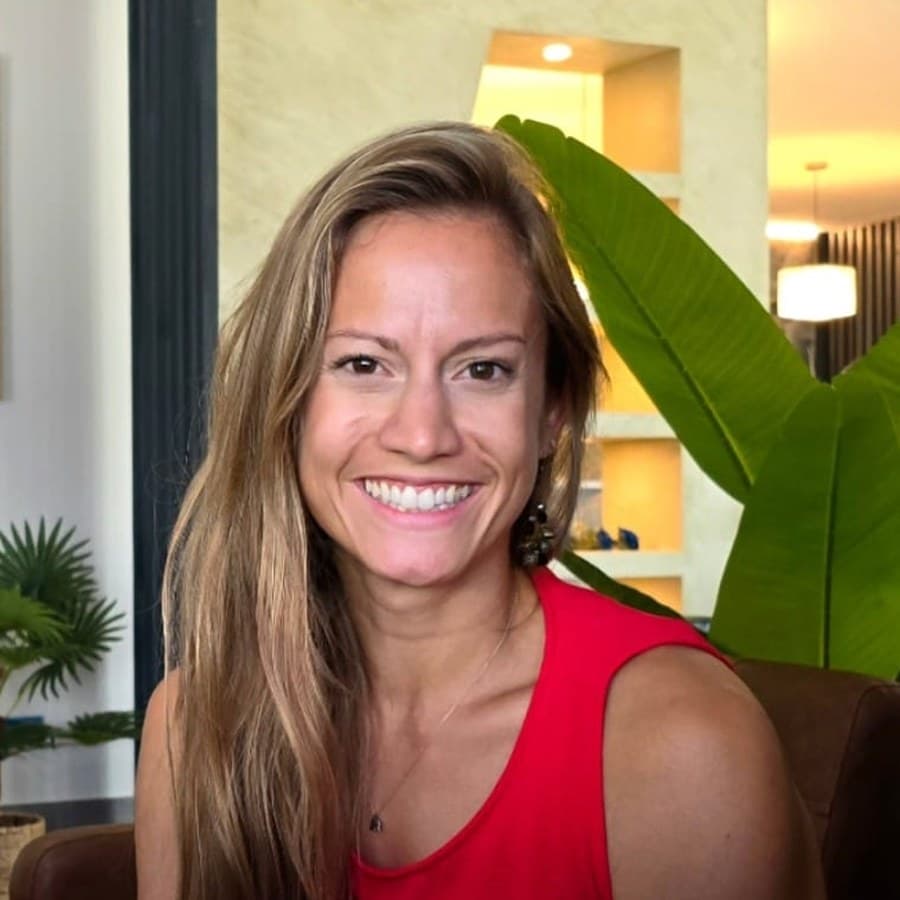
Early days
She was born in Brazil, raised in the United States from the age of twelve. Her mother taught English, having done her own schooling in the United States, and the appetite for languages and unfamiliar places is hers. Her father is an electrical engineer, and Diana spent her childhood building things and climbing trees.
“I was essentially the little boy he never had.”
Her mother worked relentlessly, at times two and three jobs, so that the family would have every opportunity going. She grew up in gymnastics from the age of five until fourteen, sometimes practising four to five hours a day, five times a week. She was never the best athlete in the room and trained like someone who knew it. What it left behind was the knowledge that she could do hard things physically, and that the knowledge would travel. These days it is longer-distance trail running.
“Doing hard things physically taught me that I can do hard things emotionally and mentally.”
The long way round
Her first job, while still at school, was as a server in a Brazilian restaurant. Within months the owner had put her in charge of the servers on her shift. She was sixteen, and most of them were older.
“It gave me a little taste of carrying the room, in a situation where the external world doesn't necessarily give you the authority or approval.”
It became the pattern. She meant to be a diplomat, studied international relations at New York University, left rather than take on two hundred thousand dollars of debt, and finished in economics and international studies in Utah. Her first job out of university was as executive assistant to a president of global sales and operations, who decided the role was too small for her and lent her out across marketing, product and business technology.
Then a decade of deliberate detours. She qualified as a personal trainer, taught herself to sew, and built a leather bag business she ran entirely alone, from the designs to the website to the stalls she sold from. It took her to Italy and closed there a year later, under conditions no small maker could survive and a pandemic on top. She knows from the inside what it costs to put everything into something you have made and then stop. Day trading, project management and brand strategy followed.
Five minutes in a hallway
She met Bart van Nol at a roundtable where he had come to speak. She watched part of his presentation, saw how it landed in the room, and spoke to him briefly in the hallway. She had to leave before he finished and never said goodbye. He messaged her afterwards to thank her. She calls it synergy at first sight: not an opportunity, but a person whose clarity and drive were plainly real, and a purpose she could stand behind without having to talk herself into it.
“No matter the money, no matter the hurdles, this was a person that I could stand behind.”
She has never wanted to found anything herself, and the reason is not modesty.
“I do believe I can do anything. It doesn't mean I should do everything.”
Too many interests, and no natural way to choose between them. Another person's clear purpose supplies the focus she cannot generate alone. She arrived to find a company that had opened its first markets and almost none of the structure required to open more.
How she works
She starts with why, and will not move on to how until she has it. A request that arrives already shaped as a solution gets handed back, because the person has usually gone looking for answers to a question they have not examined. The why belongs to the founder and has to be protected. The how is malleable, and the how is hers.
Then she builds so that it does not depend on her. Whatever she sets up, from a hiring process to the opening of a new market, is written down firmly enough that someone else can run it in a country she has never visited.
Moving parts do not unsettle her, because she has usually been through them already. She works out how a plan can fail while it is still a plan, and tends to have the alternative ready before anyone thinks to ask.
Very little of it has been done alone, and the asking turned out to be a skill of its own.
“There is power in making it as easy as possible for someone else to help you.”
She also holds the line on small things. In the weekly alignment meeting, a colleague began folding their agenda item into the few minutes set aside for personal updates, and she interrupted, because an hour is an hour. Small inefficiencies compound, and a company adding markets cannot afford to carry them.
Who she works best with
Ask a colleague when to go to her and you get a phrase she uses herself: tough love, but results.
“If you get answers to the wrong questions, that does you no good.”
She is equally clear about what she is not for. Anything technical is not hers, and she says so early, having recently lost two hours to an email signature. Those go to the colleague who handles technical matters, or to the collaborator who looks after the company's digital infrastructure. When there is no obvious person, she hands over the route she would have taken.
At a glance
- A strong opinion
- “A business can perform at a high level and still be a place where people are allowed to be human.”
- A book
- Think Again, Adam Grant
- The question she keeps asking
- “What is the why?”