
Home / Marco Locatelli
Marco Locatelli
He took three sabbaticals to chase things that had nothing to do with work, and learned that a company is, above all, a people business.
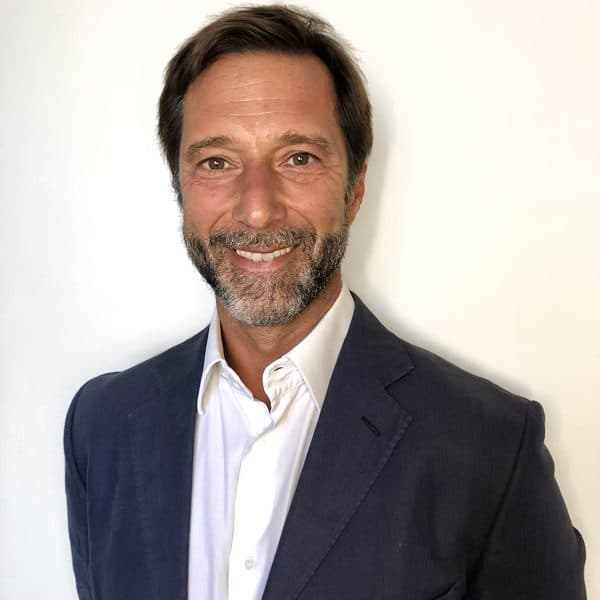
Early days
He grew up in Milan with both parents working, which left much of his upbringing to his German grandmother. His mother spent thirty-five years as an executive assistant at Lufthansa's headquarters. His father trained as a mechanical designer before moving into entrepreneurship in healthcare.
The trait that would define him showed up early and physically: he wanted to know how things worked, and took apart the household appliances to find out. At ten he got hold of one of the mysterious new home computers, and reached a conclusion that shaped everything after it.
“I quickly understood that programming was much more fun than video gaming.”
Within a short time he was among the first developers working in Italy, earning enough that he never again had to ask his parents for pocket money. He looks back at that without any false modesty.
“Retrospectively I can sincerely admit that I had entrepreneurial DNA.”
Away from the work, the pattern holds: meditating in nature, yoga, climbing mountains, diving oceans. Alone is good; with his son or close friends, better.
Three sabbaticals
He has stopped working entirely three times, each time for something particular.
The first was to sail around the world, in the manner of Bernard Moitessier, the French sailor he calls his myth.
“Discover the world in total respect of nature, away from all conformism, with lots of time and little budget, stripping myself of all unnecessary material stuff.”
The second was fatherhood, taken properly. When Leo was born, he and his partner both left their jobs and moved to a small house on the beach so the baby had their full attention, away from noise and distraction.
The third was the mountains. There were more he wanted to climb and ski than a week could hold, so he took an entire season, and reports that even that fell short.
Underneath all three sits a single principle.
“Do what you like. If you get paid for it, that's even better.”
The people lesson
The hardest thing he has been through in business had nothing to do with strategy. In one of his companies, the founders drifted apart, and the point of no return was exact.
“I knew it was over when I found out that the founder made decisions on behalf of the company in his own personal interests, without letting me know. The trust was gone overnight.”
Both the professional and the personal relationship ended, and only after a legal dispute.
He locates the failure precisely, and not where most people would. The plan was never the problem. He knows what to do when a company's survival is genuinely in question: keep control, put the emotion aside, get everyone behind a shared plan B. That works, provided everyone commits to it. What no plan survives is people who have stopped pulling in the same direction.
Hence the lesson he still carries, which he states without ornament: running a startup is mainly a people business.
How he works
Answers are not what he offers first. His purpose is to make a founder better at deciding, which means beginning with diagnosis rather than solution: why they are stuck, and which parts of the situation are facts as opposed to assumptions and emotions wearing the costume of facts. Large decisions get broken into small, testable experiments instead of being treated as one impossible call, and the cost of doing nothing is weighed against the risk of acting. Only at that point does the insight become a commitment, with a plan and accountability attached to it.
None of that begins before he knows the person. He wants to understand where a founder's energy and motivation come from, what they have succeeded and failed at, how much uncertainty and complexity they can carry, and what their life looks like outside the company. That time is not preliminary. It is what everything else rests on.
An emotional session slows down rather than speeds up. He does not judge, does not hurry, and stays curious, separating the feeling from the facts sitting underneath it. Once things settle, he resists solving the whole problem at once and looks instead for one concrete step forward.
Where he presses hardest is on avoidance: the founder who can see trouble approaching and will not say so out loud.
One example of what that produces: a client who went from idea to market launch in nine months, and won an ISPO award for Best Outdoor Product of the Year.
Who he works best with
A founder who trusts, commits and genuinely leads. Someone able to move a team behind a goal, in a company where the work is demanding but people are glad to be there.
He is plain about the opposite. A founder who will not be accountable, who does not build trust, and who cannot put a strong team around themselves is not someone he can help.
At a glance
- A strong opinion
- Better to launch a product that is good enough, on time, than to spend time and money perfecting something nobody wants.
- A book
- The Right It, Alberto Savoia
- The question he keeps asking
- “Why are you doing this?”