
Home / Ned Pamuk
Ned Pamuk
A drummer and a sailor who builds companies designed to run without him. He learned the hard way that it is culture, not cash, that carries growth.
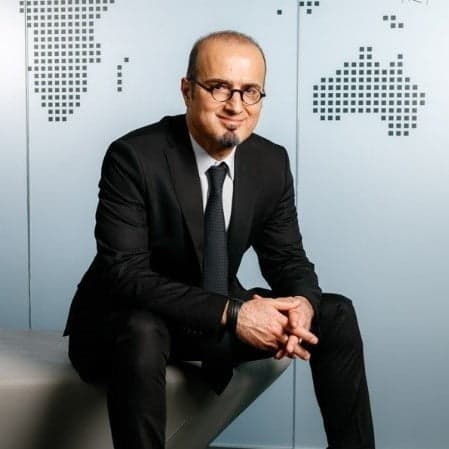
Early days
He grew up in Amsterdam, one of six children. His mother was busy on every front, socially and across the family businesses. His father was a saxophonist and singer, and also an entrepreneur with a talent for beginnings: among other ventures, he opened one of the first Turkish bread bakeries in the Netherlands.
The division of labour in that household is one Ned would later recognise professionally. His father was the visionary and the initiator; his mother, trusted as second-in-command, ran the daily operations. His father's real passion was always the music.
Childhood was school, playing music, and helping in the family businesses, which meant entrepreneurship and performance arrived together and never separated.
In the final year of his economics degree he started his first company, a small Délifrance franchise in Haarlem called Sofie de France, selling freshly baked French bread and sandwiches. Then an international opportunity in IT appeared, allowing him to pursue a long-standing ambition to become an international businessman. So he asked his brother to run the sandwich business, and they sold it six years later.
That was the beginning of a career in the international business software industry, working mainly with American software companies.
The hard part
The company grew very fast, and going public was fashionable. After the IPO, managing the expectations that came with being publicly listed proved harder than expected. At the same time they began acquiring international partners, without paying enough attention to something he now regards as decisive: cultural fit.
The acquisitions did not deliver, and the consequences were serious. What followed was the part he still describes as the hardest leadership experience of his career: downsizing the company while the stock market applied continuous pressure to deliver.
“Numbers are one thing, but behind every cost reduction are people.”
Trying to protect the best people while making difficult decisions about others is a position he does not romanticise.
“Growth through acquisition is relatively easy on paper. Integrating people, cultures and expectations is where the real work begins.”
The broader conclusion is the one he now brings to founders: it is not the cash or the investment that enables sustainable growth. It is whether the leadership and the culture are ready for it.
Music and the sea
He is still a drummer, playing in a band that performs its own material alongside vintage jazz and Latin-inspired music. His listening runs wide: Bowie, Miles Davis, Herbie Hancock, David Helfgott, and bands from De Staat and Bilal to Arctic Monkeys, the Red Hot Chili Peppers and The White Stripes.
He is explicit about why any of this belongs on a page about coaching.
“What attracts me to music is similar to what attracts me to entrepreneurship: creativity, improvisation and interacting with other people. You need structure, but the interesting things often happen outside that structure.”
The sea is the other passion. He is a sailor, and for more than twelve years kept his own yacht in the Aegean. Since the pandemic he has chartered instead, in different parts of the world, which has given him new sailing grounds and new cultures to encounter. Sailing, for him, is not relaxation by the water; it is the wind and the weather and whatever else arrives. And there, he suggests, is the second parallel with running a company: you know where you want to go, but you cannot control the wind, so you adjust your course continuously to get there.
How he works
He begins with the founder rather than the business, wanting to understand how they think and what the company actually means to them before examining anything operational.
When someone is stuck, his instinct is to understand the why and then challenge the risks, rather than supplying a route out.
Emotion in a session he treats as information. He separates the person from the situation, on the understanding that people sometimes need to feel fully heard before they can think clearly again. Then he looks for facts before interpretations, and for the underlying system rather than the symptom.
“An emotional moment is an opportunity for growth, provided we don't stop at the emotion itself.”
What he pushes on, relentlessly, is focus.
“Pruning is growing.”
Who he works best with
An ambitious founder who has recognised that scaling the company requires them to evolve as a leader.
The mismatch is straightforward: a founder hunting for quick growth hacks, or looking for someone to confirm what they already think.
At a glance
- A strong opinion
- “Growth is not revenue. It's the impact created in one's life.”
- A book
- The Sane Society, Erich Fromm
- The question he keeps asking
- “Why?”